
In this post, I want to bury the lede. I think Bryson Graham, for the most part, has said and done a lot of good in his short time helming the Bulls. Specifically in the first round of his first draft, which is extremely important.
But I feel a need to nitpick on this early shortcoming of the second round transactions to pick up the slack for a largely disinterested and deferential (or, more simply, in a honeymoon period) coverage of the team.
As I said at the time, the selling of picks for cash is literally indefensible, so Graham is inherently on his back foot and looking a bit foolish in the attempt. To his credit, he isn’t running and hiding, addressing the second round in the introductory press conference of his first round picks, plus interviews with The Score and AM1000.
Graham’s explanation - for trading #38, there’s literally nothing justifiable to say regarding outright sale of #56 - has been consistent:
The board dried up, with the pool of players available in the 2nd round (even at an early selection) winnowed due to NIL money keeping some players in school
There are only so many roster spots, and he doesn’t want to commit one to a prospect he doesn’t like when it can be used later this summer in free agency and trades
#1 is an odd thing for a purported draft guru to admit, especially at the 38th overall selection. I guess we’ll see in the coming years if there was a prospect selected there that Graham should’ve identified. Altogether, as Will Gottlieb at CHGO rationalized last week, maybe Graham’s point with the early second round is revelatory in a way not exposing Graham executing some evil ownership directive, but that he simply received poor trade value. I held out criticism of that early-round trade until waiting to see if Kam Jones - a second-year player selected at #38 the year prior by Indiana - was a prospect target, but Jones wasn’t even mentioned and not part of the informal roster count. That means Jones is likely going to be cut while his salary is only half-guaranteed ($1.1M), and the tax-constrained Pacers’ motivation was to get another team to add that to their cap (the cash sent in the trade likely covered Jones’s salary). So that financial favor, plus the #38 pick, only netted Graham two future second round pick swaps and no additional picks. Bad value! Actually, take away the exclamation point, it’s just a second rounder after all.
Graham’s second point, about the roster, is more misleading. And, weirdly, per Bulls executives tradition. I feel PTSD symptoms having to explain this nearly every year: while every team has to cut down to 15 roster spots (plus 3 two-ways) when the regular season begins, in the offseason the roster limit goes all the way up to 20.
To the media’s (the ones asking the questions) credit, I’m glad they followed up at all on the trades and won’t consternate over why they didn’t push back on roster count, though I do wish they would at least mention it. And PR is always going to play the role of credulous stenographer. But I am a bit surprised and annoyed that fan coverage - part of how this very blog fits into the ecosystem1 - just bought this unquestioned:
“Yesterday, that logic felt a little harder to buy because they had just acquired Jones. Today, it makes a lot more sense if he isn’t part of the long-term plan.” - Bleacher Nation
“Refreshing Explanation…There is more work to be done for Graham to make this roster his own, and he needs the flexibility to do that adequately.” - Bulls on SI
Here is the current Bulls roster - with some assumptions from last week’s transactions that aren’t official until July 6th in the new league year:
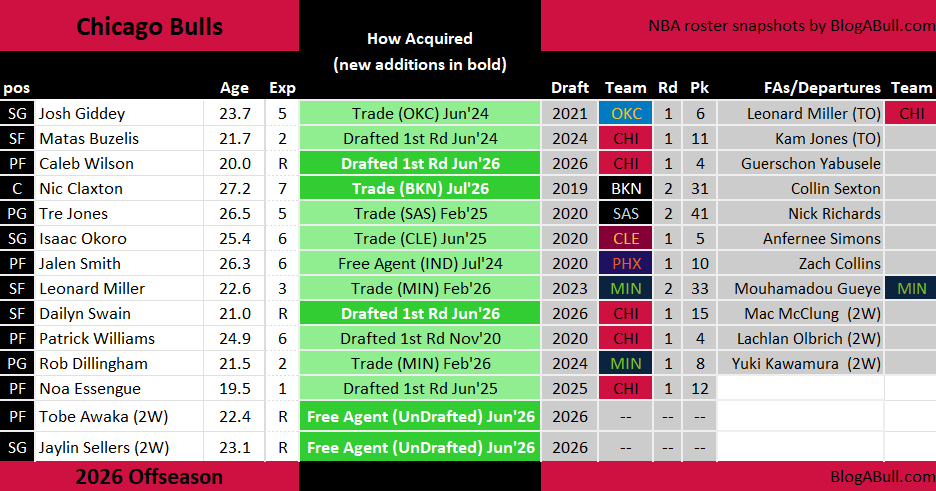
That’s 12 spots. The maximum of 20, minus 12, is 8 open spots!
The real reason Graham is framing the roster count this way is due to, what else, the cap and payroll expense.
If part of Graham’s plan this offseason is to leverage some cap flexibility towards obtaining assets attached to ‘bad money’, those players that are acquired will count on the cap…but don’t have to stay on the roster. And the team could cut - and potentially stretch given their risk calculation - relatively dead weight contracts of Williams and Dillingham. Heck, you could trade some of these other veterans (Isaac Okoro being the most superfluous) to open up a roster spot and maybe even get something in return.
Stretching this out further, if you don’t value 2nd rounders to the point you’ll trade for minimal future value or outright sell them, why not use them to open up a roster spot? As if no team would take Dillingham (1 year, $8M) if you attached a second rounder or two?
That question isn’t meant to be rhetorical, because there is an answer that perhaps is obvious but certainly wasn’t addressed by Graham, the media, or fan coverage: that hypothetical transaction - or a different one waiving a guaranteed deal to sign someone else - would cost cash. And Bulls ownership is not interested (considering, even) in losing cash, especially if the alternative is gaining cash.
I was going to wait on posting this but there has been such a flurry of moves since the draft, including trades of players (aka roster spots) using cap space and trade exceptions, that maybe the Bulls will change their roster count very soon. It won’t change that, at this time, the talk of roster spots doesn’t really hold water. But maybe that relatively minor transgression will be lost in an avalanche of acquisitions and excitement over this roster build. Fine by me! In that case, I will quickly forgive but never forget.
I don’t include YouTube ‘content creators’ in my media diet, but based on what I’ve seen from that lot in the past, they will always defer to authority and even scold other fans for not doing so
sorry it took so long - but it's so good! - NEW POST on Norm Powell signing you can paste your comments there if you'd like
https://blogabull.substack.com/p/bulls-sign-norman-powell-and-thats?r=2bo&utm_campaign=post&utm_medium=web&showWelcomeOnShare=true
Free Agency is about to begin!
A couple housekeeping transactions for the Bulls right up to the starting line:
Fully Guaranteed Leonard Miller (was a non-guaranteed team option picked up last week)
Waived Kam Jones (half-guaranteed at $1.1M on the cap)